
Key Takeaways
-
Deep excavation can alter the soil support around nearby foundations.
-
Risk depends on excavation depth, soil conditions, groundwater, building age, nearby loads, and site access.
-
Shoring is generally temporary support used during active construction, while underpinning strengthens or extends an existing foundation.
-
Preconstruction surveys, engineered plans, monitoring, and clear response procedures can help identify concerns early.
-
Safe excavation work protects workers, neighboring occupants, pedestrians, utilities, sidewalks, and adjacent structures.
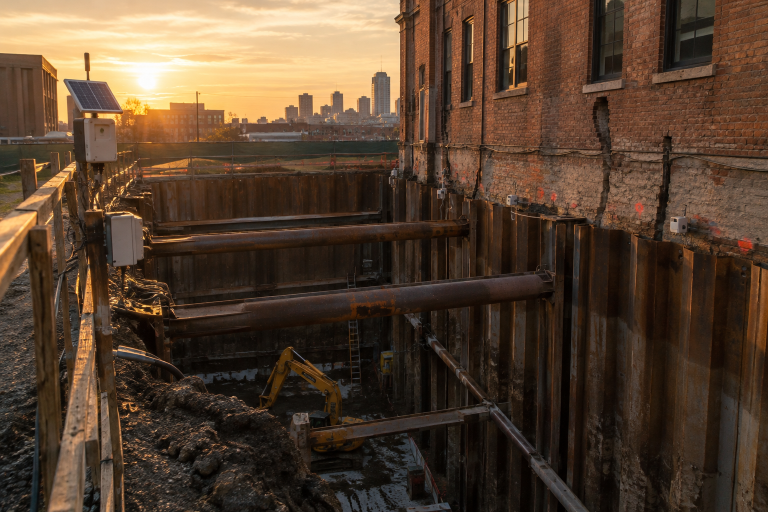
Deep excavation near an existing building is not simply a matter of digging farther down. Removing soil can change the support conditions around foundations, walls, sidewalks, and utilities. Projects involving shoring and underpinning services often require careful coordination among owners, engineers, contractors, and inspectors before equipment reaches the site.
Dense urban and suburban properties can be particularly complex because buildings may sit close to lot lines, roads, neighboring foundations, or buried utility lines. A well-prepared team evaluates the site conditions, selects a suitable support approach, and establishes a process for responding if movement, water, or other unexpected conditions appear.
Why Deep Excavation Requires Careful Planning
Every building transfers its weight through structural elements and foundations into the ground. Excavation can remove soil beside or below a nearby footing, reduce lateral support, or expose soil that reacts differently to water and construction activity. The potential effects are not limited to the building being constructed. Adjacent homes, commercial properties, retaining walls, pavement, and public areas may also be affected.
Signs of movement can include new cracks, uneven floors, sticking doors, gaps near window frames, or changes in pavement. Those signs do not establish a cause on their own, since buildings can crack for several reasons. However, new or changing conditions near an active excavation should be promptly reviewed by the appropriate qualified professionals.
What Happens When Soil Support Changes?
Soil is part of the foundation system. A footing relies on the ground beneath it to carry building loads, and the soil beside it can help maintain stability. When excavation takes place near a foundation, the remaining soil may experience changes in pressure, moisture, or confinement. The degree of risk depends on the existing foundation depth, the planned excavation depth, soil type, groundwater conditions, construction sequence, and the temporary support system.
Older structures can require additional investigation because their foundation details may be unknown, shallow, altered by prior repairs, or built under earlier construction practices. Existing drawings, past repair records, utility information, and visible site conditions can provide useful starting points, but they do not replace project-specific engineering review.
Shoring and Underpinning Have Different Roles
Temporary Support During Construction
Shoring is a temporary system used to support soil, excavation faces, structural elements, or nearby foundations while work proceeds. Depending on the project, it may include soldier piles and lagging, sheet piles, internal bracing, raker braces, support beams, or other engineered components. The best choice depends on available space, soil behavior, water conditions, excavation depth, nearby property, and access for installation.
Support of excavation systems is installed in a planned sequence. In many cases, excavation occurs in stages so the support system can be placed, braced, and inspected as conditions change. Temporary support should not be treated as a generic product. It is part of the project’s engineered means of maintaining stability during construction.
Longer-Term Foundation Support
Underpinning is a method of strengthening, extending, or deepening an existing foundation so loads can be carried safely by a broader area or by deeper, more suitable material. The process may be considered when a new excavation is planned beside an existing building, when settlement has occurred, when a basement is being created, or when a structure will carry additional load. Common approaches can include concrete underpinning, needle beams, micropiles, or other systems selected for the building and ground conditions.
In construction and renovation, underpinning strengthens an existing foundation rather than simply holding soil in place during a dig. Shoring and underpinning may be used on the same project, but they solve different problems and should be designed as part of a coordinated plan.
Early Site Checks That Help Prevent Problems
Preparation begins well before excavation. A disciplined early review can reduce surprises and establish a baseline for judging whether site conditions are changing. Important steps include:
-
Reviewing available records: Gather surveys, foundation drawings, utility plans, prior repair information, and property-line details.
-
Documenting existing conditions: Record visible cracks, uneven surfaces, water staining, sidewalk conditions, and other relevant features on nearby properties.
-
Evaluating soil and groundwater: Consider soil layers, fill, drainage, groundwater, and potential variable conditions across the site.
-
Mapping constraints: Identify utilities, streets, trees, walls, pedestrian routes, equipment access, and material storage areas.
-
Setting baseline measurements: Establish monitoring points before excavation begins so later readings can be compared against known conditions.
Monitoring During Excavation
Monitoring can help a project team notice small changes before they become larger concerns. Depending on the project, monitoring may involve survey points, crack gauges, settlement markers, inclinometers, vibration monitors, or groundwater observations. The useful part is not simply collecting readings. Measurements need to be reviewed against defined action levels and paired with a written response plan.
A response plan should identify who receives the information, who can pause work, and what steps follow if readings exceed expected limits or site conditions change. Rain, groundwater, utility discoveries, soil loss, shifting braces, or new cracking can all justify a reassessment of the work sequence.
Common Support Systems and Their Uses
-
Soldier piles and lagging: Vertical piles and horizontal lagging can retain soil along an excavation edge.
-
Sheet piling: Interlocking steel sheets can retain soil and may help control water movement in suitable conditions.
-
Secant or tangent pile walls: Overlapping or closely spaced piles can provide a relatively stiff retaining system where space and groundwater control are important.
-
Raker bracing: Angled braces can support a wall where tiebacks are unsuitable or unavailable.
-
Needle beams: Beams can temporarily carry portions of a wall or structure while work occurs below or beside it.
-
Micropiles or helical systems: Deep support elements can transfer foundation loads to more suitable supporting material.
Weather, Water, and Worker Safety
Water can quickly change excavation conditions. Rain may soften soil, runoff can erode exposed areas, and groundwater can create pressure behind retaining systems. Pumping, drainage, waterproofing, and weather planning should be incorporated into the work plan rather than treated as afterthoughts. A site that appears stable in dry weather may require different precautions after heavy rain.
Excavation safety also extends beyond the work crew. The hazards associated with trenching and excavation include cave-ins, water accumulation, falling loads, and unsafe access. Keeping materials and equipment away from edges where required, maintaining safe entry and exit routes, restricting public access, and inspecting conditions regularly are practical safeguards for workers and nearby people.
Permits, Communication, and a Safer Sequence
Local requirements may call for permits, engineered plans, inspections, property protection measures, and notices to neighboring owners. Requirements vary by jurisdiction and project conditions, so early coordination is essential. Preconstruction condition surveys and a clear contact process can help neighbors report concerns without delay.
A practical sequence is to investigate the site, complete geotechnical and structural review, identify risks, design support systems, obtain approvals, document baseline conditions, install monitoring, build supports in the planned order, excavate in controlled stages, and inspect before temporary systems are removed. When new cracks, water, soil sloughing, or support movement appear, pausing to review the facts is often the responsible next step.